

Once again someone is wrong on the internet, so I have to write about it... Luckily it's about being pedantic about something that nobody cares more than 10 seconds about.
When I started with computers resolutions were simple, you had 640x480, 800x600 and if you had a fancy monitor: 1024x768. At some point this switched to 480p, 720p and 1080p when monitors got better and computers got used for video more. Finally now we have 4k, 5k, 6k and up because numbers keep getting bigger.
Nicely in the middle of this all is my favorite monitor resolution:
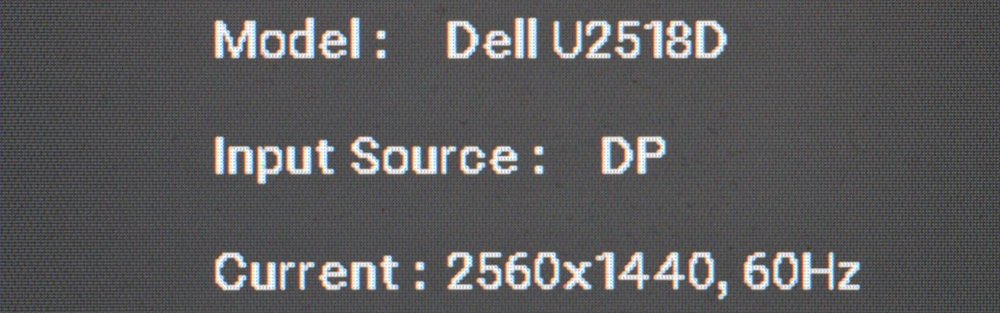
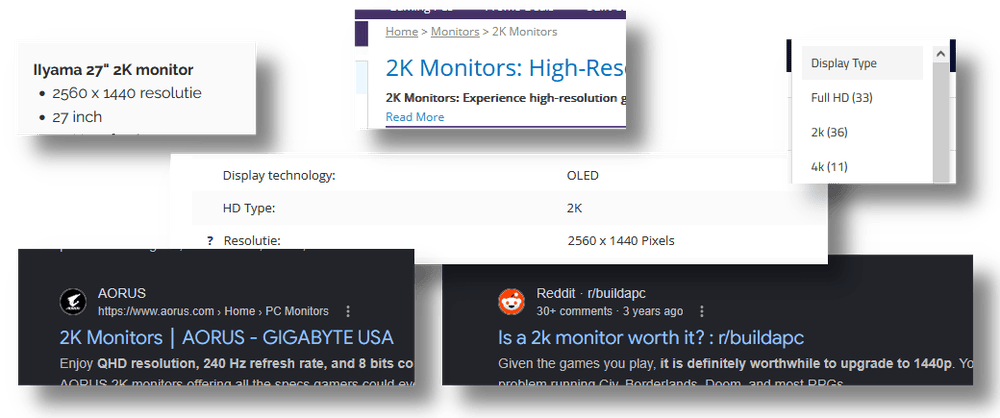
This is a 2560x1440 25" monitor, so what do you name these because 2560x1440 is a mouthful. In my opinion the most convenient way is 1440p but for some reason calling my monitors that causes blank stares whenever I mention it to people. Apparently those monitors are referred to as 2k by people online and also some webshops in the resolution filters.
Well.. a lot of resolution definitions and the way people talk about them are subtly wrong in ways that don't matter much, but calling 2560x1440 monitors "2k" monitors is just extremely wrong.
Resolution "units"
There are many ways to refer to a resolution that is not just saying the full horizontal and vertical size of the image and currently the most popular ones are the Ps and the Ks. Many people will have lived through monitor evolution and will know what these mean but clearly I'm getting old and there's now lots of people that don't know what this actually stands for.
The "P" is not a resolution unit. If you look at the 1920x1080 resolution and see that referred to as 1080p you might assume that the P stands for... Pherticar-resolution? Plines? At least it refers to the vertical axis!
The P actually stands for progressive and is more related to the refresh rate than the resolution. It's to distinguish it from 1080i which is the interlaced version and if you want to be more pedantic there's also 1080psf which refers to a 1080p signal hacked into 1080i equipment.
These resolutions originate from the dark ages with analog equipment and they are referred to by the vertical resolution because back then horizontal resolutions didn't really exist. With analog video there's distinctive lines due to the way the picture tubes work but there's no distinctive pixels dividing those lines on the horizontal axis. The only limitation for the vertical resolution is the bandwidth of the video signal through the entire video path.
Even when this all moved to the digital world the horizontal resolution could be various things depending on the aspect ratio of the video and of course then non-square pixels were also still common. From a quick look on the Wikipedia page about DVD-video there's 720x480, 704x480 and 352x480 which all would be 480p and also all 4:3 with different stretching ratios. Luckily all that remains from this mess is the letter "p"
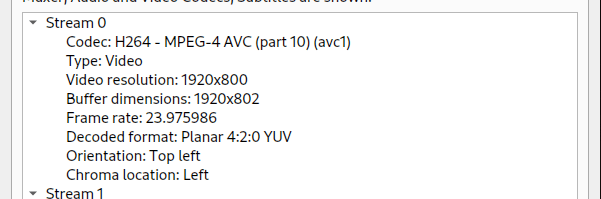
As an aside; when you legally acquire a backup of movies the movies are usually labeled as 720p or 1080p downloads. But in most cases this will be incorrect by the original definition of labeling by lines. This is because cinematic video is usually not in 16:9 aspect ratio but something wider producing black bars at the top and bottom of your screen. For example one popular aspect ratio for this is 2.39:1 (or 21.51:9 if you want to compare it to 16:9) which when digitized as 1080 would produce a 2581x1080 video file. This is of course not what you get for a 1080p download but it's actually 1920x800 in most cases... making it 800p video.
The horizontal age
So lets move on to the second "unit". Since we're scaling video resolutions by their horizontal axis now instead of the vertical one in all modern situations it would make more sense to use that for naming the formats.
Luckily we do that now by saying 4k and up. But in this case the K is also not an unit but instead it's a SI prefix (or Metric prefix) saying the horizontal resolution is 4 kilopixels. Or to be more accurate it is 4 kibipixels because it refers to the exact horizontal resolution 4096 instead of 4000.
So who of the top of their head can say the resolution of "4k" monitors and videos? Exactly! that's 3840x2160... neither of those numbers is above 4000. And that's because practically all 4k video and 4k monitors are labeled wrong, they are actually UltraHD. Only when you go to a cinema the video you're watching is actually a 4k projection (if the resolution of that cinema room is that high, a lot are still 2k). If the movie you're watching is in a 2.39:1 aspect ratio the projection is actually 4096x1716 making it true 4k, or what is referred to as DCI 4k. A lot of projections on those massive screens are actually still done at DCI 2k resolution which is only 2048x858, or just a smidge off those "1080p" files you acquired.
Rant
So that's why I'm annoyed that my nice 2560x1440 monitors are referred to as "2k" monitors, because the resolution is actually a lot higher than almost-1080p and it is closer to being 3k. Of all the shorthand names it could've been given everyone really picked the most wrong one possible.
At least the 4k label is not as bad because it's only a few pixels off from being accurate.
Naming resolutions
There's also a whole extra way to refer to resolutions, that's by their actual names. These are just so arbitrary that nobody really uses them anymore. I added a table here to list some of them anyway:
| Resolution | Name | Vertical | Horizontal |
|---|---|---|---|
| 640x480 | VGA | 480p | |
| 800x600 | SVGA | 600p | |
| 1280x720 | HD | 720p | |
| 1024x768 | XGA | 768p | 1k? |
| 1366x768 | WXGA | 768p | |
| 1920x1080 | FHD, FullHD | 1080p | 2k-ish |
| 2048x1152 | DCI 2k | 2k | |
| 2560x1440 | QHD, QuadHD | 1440p | 3k? |
| 3840x2160 | UltraHD, UltraHD 4k | 2160p | 4k |
| 4096x2304 | DCI 4k | 4k |